Attending a dinner with members of a secret society and stepping one’s toes across the speculative shroud of secrecy is easier than one would expect. Here I continued my search for the Freemasons….
Freemasonry, as their website would declare, is “one of the oldest fraternal organizations in the world… [uniting] men of good character who, though of different religious, ethnic or social backgrounds, share a belief in the fatherhood of God and the brotherhood of mankind.”
The basic concept of Freemasonry is a non-political, religiously unspecific fraternity. The requirement to join is to be an adult man who believes in a supreme being, which can be God.
Famously, the Fraternity has secrets and rituals which are not openly shared with the public. This casts a suspicious light onto the organization, the largest critic being the Catholic Church, who offer the official stance that Freemasonry is “incompatible with the Catholic faith.”
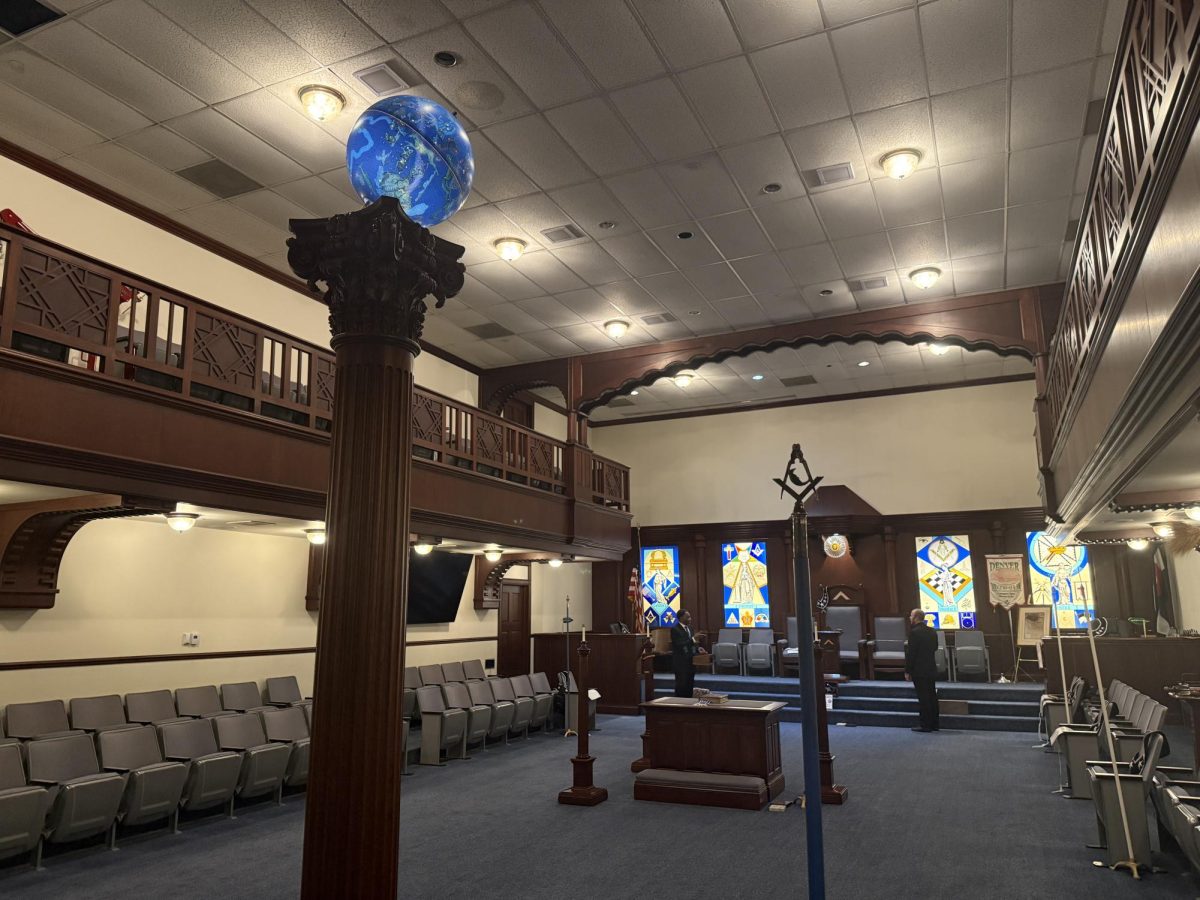
I found myself at an Old Masonic lodge, No.5 in Downtown Denver, off of 16th Street.
Up a handful of floors, I found the company of five or six suited men who were aged from ages of thirty up to seventy. I felt underdressed and bewildered. Bewildered because I felt like I took a wrong turn onto a movie set, or a museum, and as if I was in a place so familiar, yet alien. The layout was similar to an office floor plan; however, the furniture had an antique quality, with floral-printed sofas. Plaster walls were decorated with paintings of George Washington and artifacts enclosed in glass. There was a cafeteria and dining hall, and all the halls circled around a large, expansive room, which was ornamented with wood paneling not dissimilar from a church nave or a courthouse.
After the introductions and a quick tour of the expansive web of halls, I was kindly served dinner.
Here, I was introduced to Adrian Fulle, a Freemason. He wore a blue suit and talked quickly with enthusiasm, first explaining to me: “It’s really important to note, Masonry is not a secret society… it is essentially a society with secrets.”
The larger question, the mystery of the Freemasons, is why there is a need for secrets?
“The lessons that are taught in the three degrees are about building a better character,” continued Fulle. Then he thought up to the ceiling, “Do you know anything about Alchemy?”
“Alchemy?” I said.
Adrian beamed with enthusiasm and agreed,“Yes, yes! When an alchemist goes to create a formula, what they’re effectively doing is changing themselves, their own personal character. Similar in masonry, the idea is sort of like self-help.”
To address my grin and discern my skepticism, Fulle explained, “It’s a metaphor…. Well, there are guys who do that. I have been in those labs; it’s not a masonic practice. We don’t practice alchemy in the lodge.”
Adrian noted how “similar to college, [Freemasonry] is meant to make good men better, but not to make bad men good. Freemasonry has some esoteric traditions dating back 3000 years, with the 1717 formation of the Grand Lodge of England, which was essentially a stone masons guild.”
Stonemason guilds were involved with the creation of some of the world’s most magnificent cathedrals. Adrian highlighted how “everybody wanted those jobs, so the guilds created passwords and secret handshakes, to let other masons know they were legit stonemasons.”
The link between these antiquated guilds and the Freemasons I spoke to is the application of the style of old stonemason education, and using it as a metaphor for an individual’s own life.
As dinner was concluding and they began their ceremony, I asked Adrian why people are so skeptical about freemasonry. He explained, “You don’t talk about it in public unless someone asks, and people think we are running the world, but [the criticism] is essentially a bunch of religious groups that don’t agree with us.”
Further, he explained, “There is no bait and switch in masonry; it is exactly how I am telling you.”
The Freemasons still exude an element of mystery for me. A charitable and educational organization, with scholarship initiatives and healthcare services, yet there is an undeniable tie to the spiritual, the esoteric, and, in essence, the strange.