
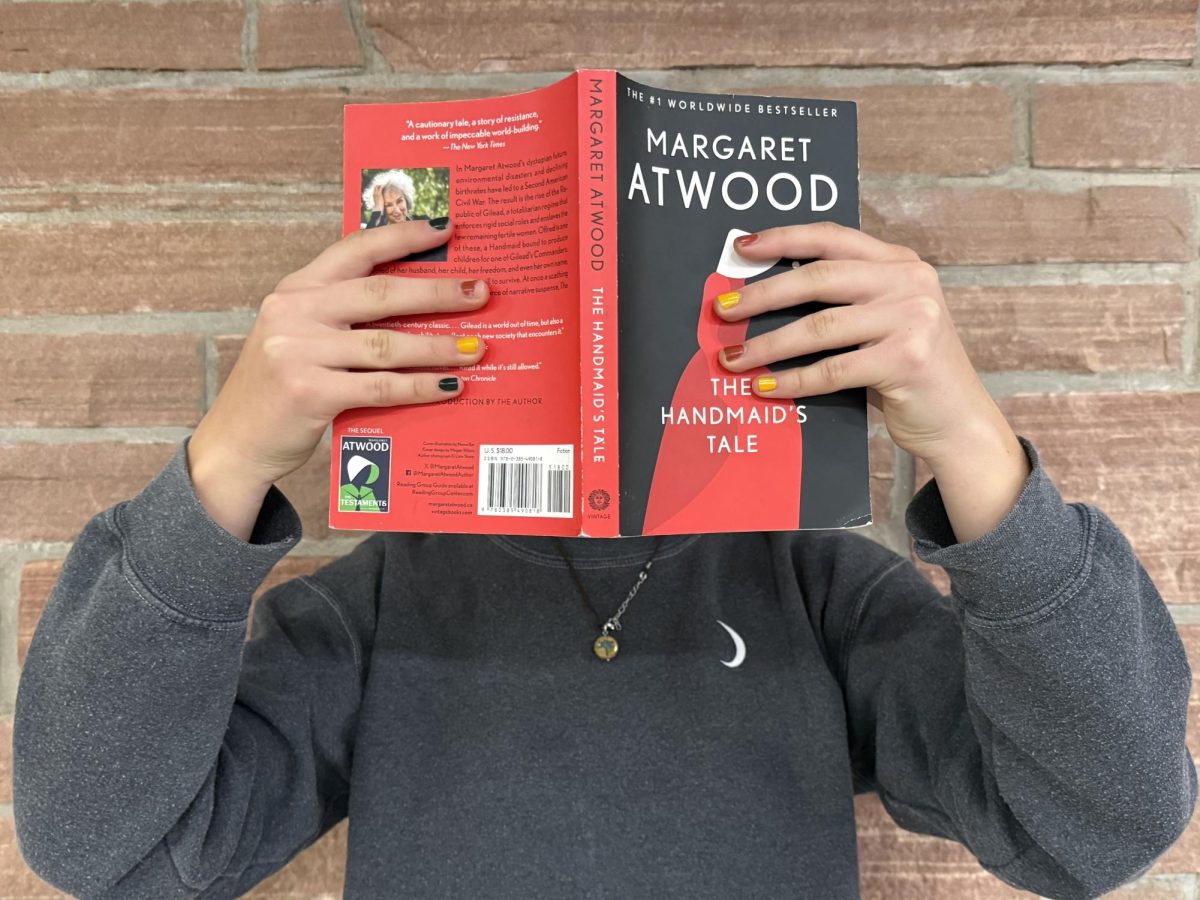
The Handmaid’s Tale by Margaret Atwood is a distinct, defiant, and culturally important dystopian novel, written as a warning against patriarchal authoritarian control. But, as the US government continually censors content that challenges power, it feels less like a narrative and more like a mirror.
Set in Gilead, a theocratic dystopian society formed to combat infertility, Atwood writes that to preserve the population, the society enslaves fertile women, labeled “handmaids,” and forces them into reproductive servitude. The narrator, a handmaid, reminisces of her previous life as a free woman and reflects on the psychological and physical control exerted over women. Atwood’s striking writing through the eyes of an unreliable narrator is fantastic; the story has been adapted into a film, TV series, opera, graphic novel, and a ballet, as well as echoed as a symbol of oppression by many at protests globally.
I loved the book’s clear messages on female empowerment, sexual violence, and conformity. It is truly such an important piece of defiant literature that I highly recommend, and I rated it five stars, a nine out of ten. However, it is the victim of a mass censorship: book banning.
Even with the legacy of Atwood’s story, The Handmaid’s Tale, along with hundreds of other titles, is being removed from various libraries across over half of US states due to claims of profanity, vulgarity, and sexual overtones. The Trump Administration is encouraging books that are “sexually explicit,” “un-American,” or promoting “gender ideology or divisive concepts” to be removed from libraries and public school curriculum.
In 2024, the American Library Association documented that 2,452 books were challenged for removal, and that 72% of those came from political pressure groups and government entities. The books challenged range from documents of diverse racial experiences to seemingly mundane topics.
Some of these books include The Hate U Give: a bestselling novel about modern racism, Where the Wild Things Are: a widely-known picture book about a child’s dream of meeting fantastical creatures in a forest, or, my personal favorite, Freckleface Strawberry, a picture book about a young girl learning to love herself and her freckles. None of these books are sexually explicit, dangerous, or vulgar: unless you count diverse experiences, imagination, and self-love as dangerous concepts.
The Handmaid’s Tale is about female oppression, the glorification of fertility, and a prominent sexual violence crisis, all things that mirror the current climate of the United States. By banning this novel, it only furthers the striking parallels between the dystopian society and our own. Atwood’s writing is a warning, not a blueprint.
Book banning is a nuanced issue, and doesn’t refer to removing children’s access to books due to age-appropriate content restrictions; the issue is removing defiant, dystopian, and diverse literature from public libraries. Public libraries are governmental units, which means, under the first amendment, they are required to be secular and cannot have religious or political affiliation. These bans are a violation of students’ first amendment rights, specifically the pursuit of information: contrasting the Trump Administration’s claims that book bans are not a civil rights issue.
The diversification of books and literary material is a crucial component of education. By censoring books, usually ones with diverse representation, it isolates people of color, LGBTQ+ individuals, and those whose stories are represented by books off the thoroughly beaten white and Western literary path. I greatly recommend this novel, both for the important story it conveys and for what it fights against.
Francesc Estorach • May 10, 2026 at 12:52 pm
Muy buena reseña. Gracias por tu análisis del cuento. Te deseo mucha suerte en tu empeño por defender la libertad i los derechos de las mujeres, especialmente en el triste momento que vive Estados Unidos. Ánimo!
Elizabeth Snyder • Mar 19, 2026 at 12:02 pm
Such an interesting read. Very scary, the parallels between this novel and present-day climate. Nice job, Lynley- I read your bio after finishing the article and never would have guessed you were still in high school. Keep up the good work!