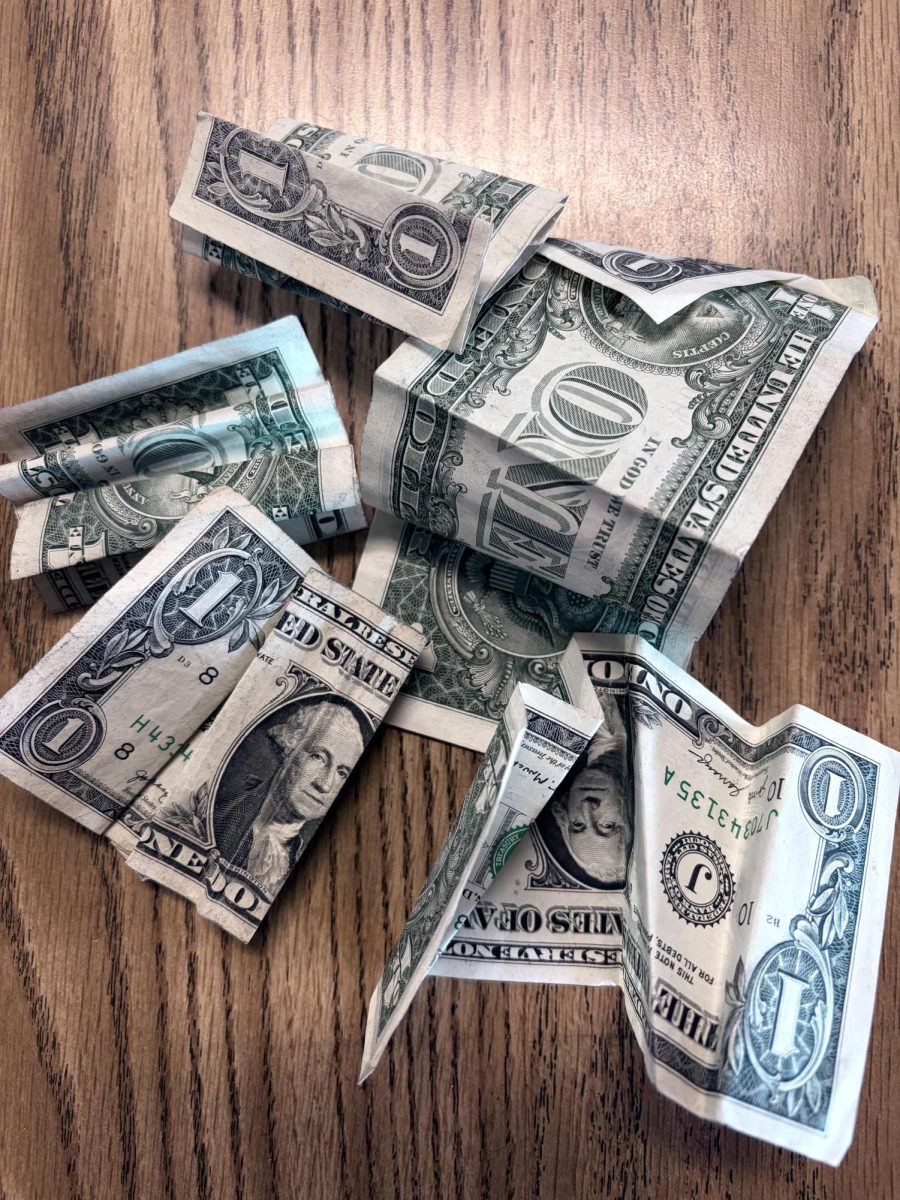
As Lil Uzi Vert professed, “In reality I’m five-five, stand on my money, now I’m six-six.” However, With the rise of digital payment technology, it is easy to see how cash could become obsolete. In 2026, I wanted to answer the question: Do high school students still roll old school with cash? Or has digital currency taken over?
To find an answer, I interviewed over 60 students at Boulder High… and the results were surprising. Only forty-eight percent of students still use cash at all. Even more shocking, of that forty-eight percent, only fifteen percent of cash users rely strictly on cash, or seven percent of the total group. Still, some students defend cash. One anonymous student points out that “using a card prompts the screen to ask for preselected tip values. For cheap skates, using cash saves more money in the long run, because cashiers just give you your change.” Despite this, most students are quick to argue in favor of using online payments. Joaquin McKee, ‘26, claims, “change is annoying to deal with, especially when you get to handling nickels and pennies.” Beau Dunbar, ‘26, stated, “I believe online transactions are the next step in the theoretical plane of human transaction, as they pertain to future endeavors.” Overall, the consensus seemed to be that digital transactions are easier and more practical than cash exchanges.
But does digital spending burn a bigger hole in your pocket than cash? Since online transactions require just a tap, it may contribute to students’ struggle with overspending. John Crowns, ‘26, lamented, “With Apple Pay, I feel like spending money is less ‘real,’ and it can be harder to realize how much I lose.” Crowns recently spent upwards of forty dollars at McDonald’s over the course of a single weekend. Conversely, spending cash requires physical action, which can feel more tangible. Handing over cash can make the “pain” of paying higher, which can reduce impulsive spending.
Calvin Harvey, ‘26, states, “real men, we run on cash,” highlighting the longing of certain students to stick with an “old money” aesthetic. Additionally, some students use cash because it’s untraceable, and not everyone wants their spending tracked and regulated.
Despite this, it’s not hard to imagine cash vanishing from society in the future. However, there is a somewhat sad aspect to this new method. When handing over cash, there is a small interaction between the buyer and seller. With a tap-to-pay method, our society loses another small yet important interpersonal interaction. This can further contribute to isolation and a loss of community. Online cash has also led to higher use of self-checkout. This seemingly efficient process nixes social interaction, such as the small conversations between a cashier and their customer. As brief as these interactions may be, they serve a societal purpose. In this way, the future of transactions may be detrimental to us all. If society abandons cash, it risks forgetting how to connect with others and losing spending discipline.