
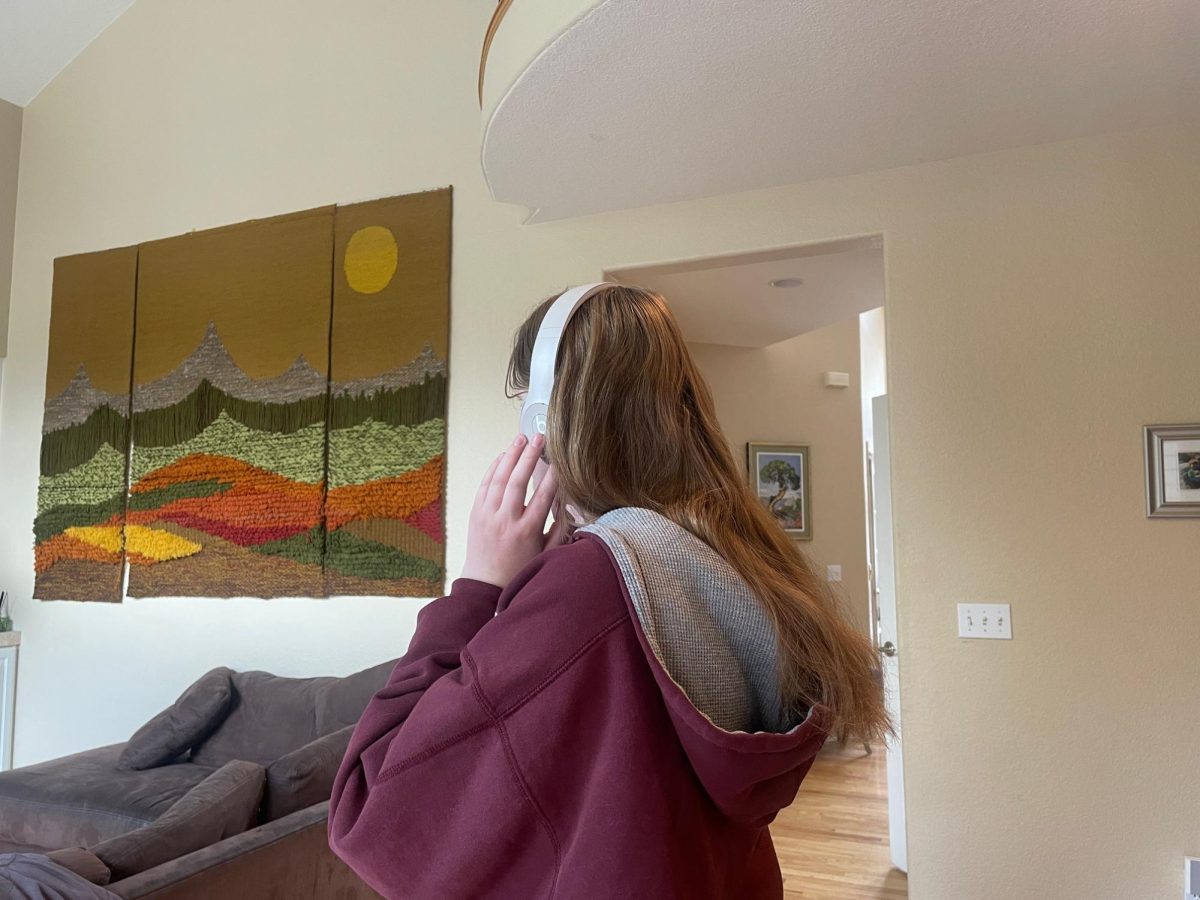
Have you ever listened to your favorite song and suddenly felt a chill run through your body? You see goosebumps on your arms, even though you aren’t cold. What connects your favorite song to this biological response?
According to an article in The National Library of Medicine, these chills are called aesthetic chills, or musical frisson, and result from a pleasurable psychological reaction to a moving stimulus. This is characterized by chills or tingling in your arms, back, or neck, usually triggered by music or sounds.
A dopamine rush causes these aesthetic chills. Dopamine is triggered by happiness, rewards, and stimulation. In this case, dopamine is released as a reward for listening to emotionally stimulating music, kind of like it would for a hug or food.
Something called Bilateral Stimulation plays an important role in the connection between your favorite song and getting chills. Bilateral Stimulation is a cycle alternating stimulation between the right and left sides of the brain; the main causes of this stimulation are either visual or auditory. Music does this naturally through auditory rhythm. When combined with emotionally intense memories, the effect intensifies.
Those memories do not have to be very powerful memories to matter. Even a small but meaningful connection to a song can trigger frisson. If you heard a song during a specific moment, like a beautiful day, a road trip, or a breakup, your brain stored the emotions that you felt along with the music. Now every time you hear it, both the emotion and the memory of the moment trigger together.
Your brain is constantly seeking what comes next in a song. When a song does something unexpected, your brain gets a little jolt. That experience of expectation triggers a dopamine spike, which is part of what causes frisson.
That isn’t quite a surprise; it’s a buildup before the drop, like on a rollercoaster. Your brain, anticipating something, releases dopamine. You are able to get goosebumps from a song you have heard a million times. That is because your brain expects the drop in the beat, and it starts placing dopamine before it even hits. This is called reward prediction; your brain rewards itself for correctly predicting that something emotional is about to happen.
But goosebumps were never meant to be emotional; in fact, they were built for survival. The biological aspect of goosebumps is that they evolved as a survival mechanism. When early humans were cold, goosebumps caused tiny hairs on their arms to stand up, which trapped a warm layer of air close to their bodies. This also happened when humans were scared; this made them look bigger to their ancestors, like how a cat puffs out its fur.
Somewhere along the way, the nervous system that triggered goosebumps for the cold got connected with emotion. The autonomic nervous system, which controls involuntary responses like heart rate and breathing, stopped distinguishing the difference between the two.
When music hits your emotions hard enough, your nervous system ends up treating it like a physical event. The overwhelming emotion that you can hear from your favorite song is seen as a real event to your brain, so real that it triggers a biological response.
Only about ninety percent of people experience musical frisson. Researchers think that this comes down to the personality trait of openness to experience; people who score high on this tend to be more imaginative, curious, and emotionally receptive.
Studies have found that people who experience frisson have a slightly different brain structure. They tend to have more connections between the auditory cortex, the place that processes sound, and handling emotion. Basically, their brains are more ‘wired’ for music to feel emotion.
It’s not about how much somebody loves music. Plenty of people who feel passionate about music will never get to experience musical frisson. It’s about how well your brain processes emotion in response to sound, which can vary from person to person.
So next time you feel goosebumps listening to your favorite song, know the connection between this odd feeling and your body, because it took a long time to get there.