Would you put your life in the hands of a robot? I did. And survived. Over spring break, I took a trip to San Francisco: one of the tech capitals of the world. The city is covered in cutting-edge technology, from the robot barista at SFO airport, to the AI billboards on every street corner, to a fleet of self-driving cars called “Waymos” serving as a driverless alternative to Uber and Lift.
I didn’t know much about Waymos when I first got to SF, but it surprised me how apparent they were on the road. These cars were everywhere. My friend and I decided to download the Waymo app and attempt to ride one to a stop on our trip itinerary. The service had only opened to the public in San Francisco in 2024, a long way from its origins as “Google’s Self-Driving Car Project” back in 2009. I’ll be honest: it was pretty perfect. The app lets passengers adjust the air conditioning, music, and seat settings all to their liking, while riding in a clean, comfortable Jaguar. The turns were smooth, the stops were smooth… the whole ride was smooth.
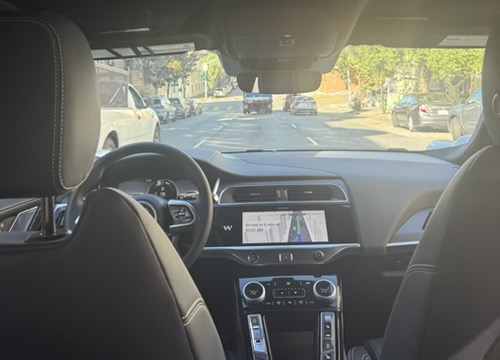
And yet it almost feels too perfect. What struck me most was how human the car still was, despite having no human driver. It has a backup mirror, a front console, and familiar controls – all things that exist for people, not robots (possibly to make people feel more comfortable riding in them). Watching the steering wheel turn itself, navigating other human drivers rushing around, was both fascinating and eerie. Each Waymo also identified other vehicles on the road, distinguishing fellow Waymos (with a full car image) from regular cars (which appear as blurry blobs on its display).
I had been pretty indifferent to Waymos until one of our last nights on the trip. My friend and I decided to order a Waymo because it was cheaper than Uber from our location (which happened pretty often), and as we stepped into the sleek vehicle, I noticed a girl who looked about 20 sitting on the road’s stoop. She was smoking a cigarette, staring at me, then at the Waymo, and then she shook her head. That moment stuck with me, and was what incited me to write this article.
Why don’t people like Waymos? I began to research further. In my research, I found that many view the Waymo car as unethical, often due to concerns about driver job loss, the use of surveillance technology, and questions about responsibility in the event of accidents. Compared to Uber, the contrast between the two is astronomical, and there are both pros and cons.
Let’s start with the pros. Depending on demand, Waymo was usually much cheaper than Uber, especially when factoring in that Waymo doesn’t accept a tip. As I mentioned previously, Waymos are also controlled environments where riders can customize their driving experience to perfection. As women in a city at night, there was also a feeling of safety within the Waymo, as Uber has had many allegations of sexual assault against its drivers. However, there were cons. Waymos have stories online of getting into car pileups, hitting cars, and even hitting a bodega cat in the road. Waymo is also rapidly displacing human drivers, which is one of its main downsides.
Riding in a Waymo may make you feel like you’re on top of the world, but that inner guilt stayed with me after witnessing the girl’s disapproval. More and more, I’ve realized that technology is overtaking our country and our entire world. This strange adjustment period is threatening and almost ominous, and I can’t help but wonder if it’s for the better or worse. Still, we all may soon find ourselves passengers in a driverless world, whether that is riding back from a concert at the Ball Arena, or to a dinner in downtown Denver. And after that, maybe streets will be filled entirely with driverless cars. My experience left me questioning whether we are advancing ethically, or simply moving forward because we can.
So would I feel ethically stained if I were to ride in a Waymo again? I’m not sure. However, I do know that I’d definitely be more alert and attentive to how my decision to ride a Waymo or not might affect the broader community.