
Your favorite columnists return yet again, for a more detailed review of one of our favorites, and one of our least favorite queer movies!
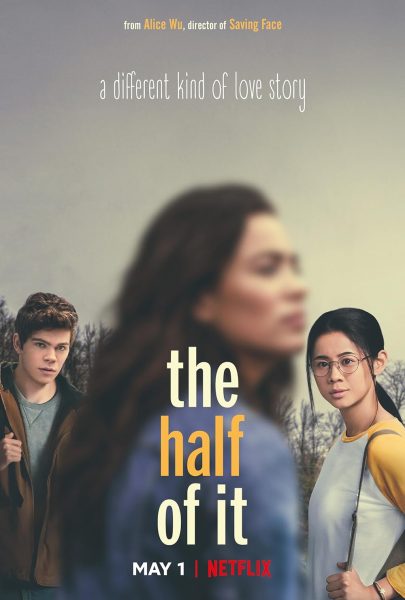
The Half of It
Alice Wu’s film, The Half of It, follows the story of a hardworking and endearingly awkward protagonist, Ellie, as she navigates her senior year of high school. Being a Chinese-American lesbian in a predominantly white and immensely religious small town, Ellie typically keeps to herself as a result of the social exclusion she faces from her fellow classmates. That is, until she meets Paul, another senior at Squahamish High.
A smart and eloquent student, Ellie also has a side gig of writing school essays for other students. Because of this, Paul asks Ellie to write love letters to his crush under his name, in exchange for a hefty payment. At first, Ellie rejects the proposal for moral reasons, but when her dad struggles to pay his bills at the end of the month, she reluctantly agrees as a last resort to make some extra cash. When Ellie began writing the letters for Paul, she never would’ve expected to become so close with the same footballer that she first pegged as a typical, popular himbo. But as it turns out, Paul wasn’t just a dumb jock—he was a dumb jock who was also sweet, funny, and one of the only people in Squahamish that Ellie learns she can count on. However, this unlikely friendship soon becomes complicated when Ellie falls hard for Astrid, the girl who thinks she has been exchanging letters with Paul, and it becomes even more convoluted when Paul is forced to overcome his prejudice as he discovers that his close friend is a lesbian.
Although the plot may lead many—including me, originally—to presume The Half of It is a typical high school romcom, it is so much more than that. It covers heavy topics such as prejudice and a sense of belonging, is quite philosophical at times, and feels surprisingly realistic. With the combination of quality acting and natural dialogue, the main characters feel like real people, ones that the viewer can’t help but root for as they navigate through love, a sense of identity, and acceptance. However, it’s not only the characters that feel real. The relationships between them are also immensely believable, despite the cliches that Wu employs. Though the most developed plotline is the friendship between Ellie and Paul, the romance between Ellie and Astrid, as well as the father-daughter relationship are also realistically portrayed, sweet, and complex. Despite the heavy themes this film covers, the heartwarming moments and hopeful ending develop an emotionally well-rounded mood, rather than a depressing one. The peaceful and beautiful cinematography is the cherry on top, further contributing to the comforting atmosphere of Wu’s film.
The Half of It is a warm cup of tea on a rainy day, and once again, Alice Wu—who also directed the iconic 2000s film Saving Face, which we reviewed in December—didn’t fail to disappoint in creating this bittersweet romcom that will warm your heart and put a wide grin on your face.
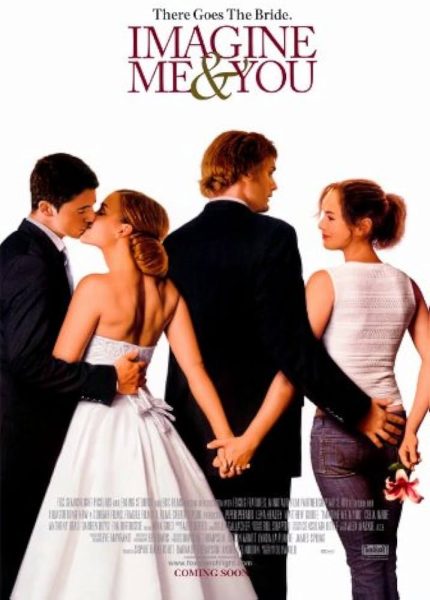
Imagine Me and You
At first glance, Imagine Me and You seems promising: a cute rom-com of the early 2000s variety, the genre responsible for iconic romances like How to Lose a Guy in 10 Days and 13 Going On 30. But starting just five minutes into the movie, it’s a hard watch, as the female love interests are introduced to each other… at Rachel’s wedding to someone else. While this tragic meet-cute is okay at first, the two begin seeing each other in secret, sneaking around behind Rachel’s husband’s back.
Cheating plotlines can almost never be cute: Rachel never has an honest conversation with her husband about her (bi?) awakening until late in the movie, and for an hour of runtime, instead chooses to cheat on him. Rachel’s husband is communicative, understanding, and a good partner whom Rachel seems to love in a way, but after discovering her sexuality, the movie imparts the idea that it is Rachel’s queerness that led her to cheat and destroy her relationship with her husband, parents, and extended family.
Essentially, the two heroines are portrayed as a wife turned dishonest by her gay awakening and a lesbian seductress and homewrecker, which, in addition to smacking of some serious homophobia, isn’t a very fun couple to root for.
It probably would have been easier to stan the couple if the actresses playing Luce and Rachel had any kind of chemistry whatsoever, but alas, it isn’t so. I guess as much could be expected from casting two straight actresses in a WLW romance. Throughout the movie, it feels as if the audience is just supposed to believe Luce and Rachel are deeply in love despite seeming cold and awkward on-screen. The script certainly tries to convince the audience, with long, melodramatic proclamations of love, but they are delivered by the “lovers” in such a passionless tone that it almost feels like the actors (and therefore characters) don’t believe or mean what they’re saying.
I have my suspicions that the person in charge of casting thought they had to cast pretty people in order to make lesbians likable, and they sacrificed good acting for conventional attractiveness. Specifically, one very consistent form of conventional attractiveness. The characters Luce and Rachel look so similar that it’s genuinely difficult to tell them apart: white, thin, and brunette, with similar facial features and identically curled hair, wearing nearly the same outfits in every scene.
Although supposedly a rom-com, it’s not funny, but rather uncomfortable to watch Luce and Rachel try to keep their relationship under the radar of Rachel’s husband. Without any comedic aspect or romantic chemistry, the movie is just bland. It lacks a soul or distinctive vibe and seems more like a cash grab than an attempt to make a good movie. What makes this sadder is that the dialogue actually could be swoonworthy, if delivered well, and in a movie where the plot doesn’t solely rely on cheating. I wanted to like this movie, but ultimately, it would take more imagination than I have patience for to pretend Imagine Me and You wasn’t a disappointment.